Showing posts with label grand lake. Show all posts

Sunday, January 16, 2011

Grand Lake St Marys update

http://thevwindependent.com/news/?p=1095

State officials briefed on Grand Lake St. Marys situation

  • digg
  • facebook
  • myspace
  • twitter
  • print
  • email

DAVE MOSIER/independent editor


Ohio Director of Agriculture James Zehringer had the shortest trip, since he lives just down the road in Fort Recovery. He was joined by Ohio Environmental Protection Agency Director Scott Nally and Department of Natural Resources Director David Mustine for a briefing held at Wright State University’s Lake Campus detailing what the Grand Lake St. Marys Restoration Committee seeks to do to deal with the problem.CELINA – Just four days after being sworn in by Governor John Kasich, the directors of three state agencies were in Celina to underscore the governor’s commitment to deal with the algae bloom problem on Grand Lake St. Marys.

The three directors, along with Mercer County Economic Development Director Jared Ebbing, a representative of the Grand Lake St. Marys Restoration Committee, and State Representative Keith Faber, later held a meeting with media representatives to provide comments on the briefing and what could be the next steps in the process.

The three state officials, who were sworn in January 10 by Governor Kasich, indicated their commitment to taking action on the issue, while Faber said he was pleased with the quick action by Governor Kasich to honor a commitment he made during the gubernatorial campaign to solve the lake’s problems.

“When John was campaigning, he came here and saw first-hand the impact on Grand Lake St. Marys and the community,” Faber said, “and he made a commitment … that this would be a priority for the new Kasich administration.

“And I don’t know how you get much more priority, as a state legislator, than to see the three directors – and really the four agencies that are directly impacted on this – coming in literally the first week they’re in office to talk to the interested parties about what needs to be done to fix Grand Lake St. Marys,” Faber added.

All three state directors were provided with a strategic plan outlining steps needed to deal with the algae bloom problem.

Those priorities include the following:

  • Sequestration of soluble reactive phosphorus to limit availability of nutrients that fuel algae and mycrotoxin development (the highest priority item).
  • Physical removal and encapsulation of nutrient-laden sediment, through dredging, as the most effective long-term means of eliminating internal nutrient loading and the controlling factor for nutrient cycling within the lake.
  • Develop opportunities to remove stressors on the ecological system through application of technologies that provide sustainable processes.
  • Establish Best Management Practices in each sub-watershed draining to the lake to intercept and remove nutrient loading prior to its entry into the system.
  • Decrease rough fish population through removal and management actions.
  • Management of the lake as an economic resource of the state, with recognition of the influence it maintains over the local and regional economy.
  • Fund the development and restoration of natural resources within the state, where the economic benefit will exceed the costs of capital investment to undertake.
  • Prioritize applications from producers within the Grand Lake St. Marys Watershed for the Water Pollution Control Loan fund, with the added caveat that use of manure best management practices and technologies be integrated into all aspects of the agricultural/livestock industries located within the watershed to decrease nutrients draining into the lake.

All three directors were complimentary of the work done so far by the Grand Lake St. Marys Restoration Committee, with Mustine saying he felt the strategic plan was “very professional.”


Although he comes from Indiana, Nally, the new Ohio EPA director, said he is familiar with the local problem since he lived near a water recreation area in the Indianapolis area called Geist Reservoir, adding that that area, which includes homes in the median range of $1 million-$10 million, has the same problem as Grand Lake St. Marys.Mustine said he was also impressed with the local fundraising efforts, which have generated $650,000 so far. “That’s fantastic and certainly inspires us to be looking as hard as we can to find ways to get resources for this effort.”

Nally also responded to a question asking what the state planned to do this summer to deal with the problem.

“There’s going to be action done this spring,” Nally said. “Whether it prevents a algae bloom this summer we don’t know, but at least we’re not going to say we didn’t try these top four, five, six top issues, we’re going to be doing things and not waiting for something to happen.”

“If you’re asking if we’re going to have action, yes, we’ll guarantee we’re going to have action,” Zehringer added. “We can’t guarantee success.”

Thursday, September 9, 2010

Grand Lake, Ohio - Update


Officials unveil information to help restore lake
Thursday, 09 September 2010
By MIKE BURKHOLDER
Staff Writer
CELINA — Ohio State officials Tuesday night unveiled another piece in the puzzle in the fight to help restore the water quality of Grand Lake St. Marys.
Directors of the Ohio Department of Natural Resources (ODNR), Ohio Department of Health and Ohio Environmental Protection Agency (EPA) held a public forum at the Celina Fieldhouse as a way to brief residents regarding a pair of pilot projects on the lake. Several hundred people who attended the meeting were allowed to submit questions to a moderator, which were then answered by members of the panel. Russ Gibson, with the Ohio EPA, gave a brief presentation regarding the alum dosing test project. The project, which is slated to begin Sept. 20, calls for liquid alum to be applied to six locations along the lake — West Beach, Harmon’s Channel, 4-H Camp, West Bank boat ramp, Otterbein channel No. 1 and Otterbein channel No. 2 — for a total of 53 acres.
“It’s designed to provide some near-term relief to reducing the nutrient loads that are within the lake itself,” Gibson said.
When introduced into the water column, the alum will bind with the phosphorus and force it to the bottom of the lake. The alum will not add to the sediment at the bottom of the lake, and Gibson said the compound poses no risks to humans, fish or other animals.
“It’s something that has been safely used in nearly every drinking water supply and treatment system — the city of Celina uses alum every day,” Gibson said. “It’s been used in more than 150 lakes successfully across the country.
“We have the literature to support that alum will be successful in helping to reduce the internal phosphorus load that is in the lake,” he said. “Just to give you an idea, Grand Lake St. Marys has a very, very high phosphorus level. Our goal with this project is to reduce the internal phosphorus and inactivate those levels by 60 to 85 percent. That is substantial.”
Gibson encouraged residents to come out Sept. 20 to witness the start of the four-day project. He also reassured the crowd the alum dosing poses zero risk to people.
“There is no harm in coming out and watching,” Gibson said. “If you happen to be around the lake one of those days, drive by and look at what’s going on.”
The new project is different than the one proposed by Gov. Ted Strickland in July. That project called for two sites of 20 acres a piece.
“We just really had a very difficult time finding two different sites that were that large,” Gibson said. “So we elected to instead do six sites that totaled 54 acres.”
Once the alum is applied via a barge, the water will instantly turn milky. Within two hours, Gibson said the results will be noticeable.
“As that alum settles down through the water column, it’s basically stripping the water of the phosphorus and other nutrients that are in that water column and the water will become remarkably clear,” Gibson said. “We do not expect Grand Lake St. Marys to become gem clear. The demonstration sites, for some period of time, will be very clear.”
The second pilot project, which is being conducted by Algaeventure, of Columbus, involves introducing silica into the water column with the hopes of flipping the bad algae into diatoms. Diatoms are a species of algae that do not produce toxins and if the conditions are right, will dominate harmful algae. That project started last week at a site near the city of Celina.
During the question-and-answer session, panel members handled a variety of questions. Some ranged from dredging the entire lake to the harmful side effects of alum.
One resident asked what is being done to rid the lake of geese.
ODNR Director Sean Logan said geese produce waste approximately 28 times a day and there are more than 2,000 of them living around the lake.
“We believe that we have a resident population of 2,500,” Logan said. “We will continue, through controlled hunts in designated locations, to continue to reduce the population.”
The question of opening up the spillway to flush out the lake was posed to the panel. Logan said that was not a viable option and would produce little, if any, benefit.
“The average length of time the water in Grand Lake St. Marys takes to come in and come out is 1.3 years,” Logan said.
Logan also said opening the spillway would fail to reduce the internal loading in the lake — a root cause of the algae bloom problems during the past two years. Logan said the depth also is as hurdle.
“Because of its shallowness, it does not have the same stratification that would lead you to believe or would it allow such exchange of water as the question asks,” Logan said. “You could open up both tubes for 24 hours and only get 1 inch drop.”
Dredging also was brought up. Logan said state official will focus on spot dredging near tributaries that lead into the lake.
“Right now, in Montezuma Bay, we are going to go a little deeper where we already have a spoil site available and there is already an active dredging project in place,” Logan said. “The key to dredging is the spoil site. Where do you put the dredged material to allow it to dewater in a quick enough fashion so that you don’t have water being your capacity. We are open to all sorts of suggestions.”
Logan said state officials are open to help solving the problem. However, he again stressed that dredging the entire lake is not a viable option.
“We do need your help,” Logan said. “We need help in identifying upload disposal sites, I think we should start with Prairie Creek. We need upload land owners to help identify where we can have disposal of this material.”
Winter manure application procedures also were posed to the panel. Logan said any manure application between Dec. 15 and March 15 would have to comply with a series of guidelines in order to be allowed. In two years, Logan said there will be a ban on winter manure applications.
“The proper crop to uptake the nutrients that are applied, set back distance from stream, the future weather and the soil,” Logan said of the requirements. “The soil will always tell you what it can handle and what it cannot handle.”
Logan also stressed that the ultimate solution is in the hands of landowners, not politicians.
“We all are part of the solution,” Logan said. “The ultimate, long-term solution to this problem does not lay with government, it lays with private landowners. You need to unite together and say that we want a better future and I know that you do. We just need to step up to the plate, each and every one of us.”
Last Updated ( Thursday, 09 September 2010 )

Friday, August 13, 2010

Grand Lake, Ohio - Update

Sand to be used as a silica source in Grand Lake, Ohio


Marysville company to begin Grand Lake project

Written by NANCY ALLEN, Celina Daily Standard
Wednesday, 11 August 2010 19:39

GRAND LAKE — A Marysville-based company will conduct a test this month in a 21 D2-acre part of Grand Lake to see if a beneficial algae species can be encouraged to grow and replace the toxic blue-green algae now dominant.

Ross Youngs, CEO of Algaeventure Systems Inc., explained the test during Saturday’s meeting of the nonprofit Lake Improvement Association (LIA).

The test site will be between the Celina Rotary lighthouse and a rock jetty.

The process, called species flipping, is one of the solutions to help restore the lake Gov. Strickland and state leaders announced during a local news conference July 30. The test will involve adding silica (sand) to the lake to encourage the growth of diatom algae that need silica to make their glass cell walls.

---------------------------------------------------------------------------------------
In nature sand is the source of silica for diatoms.
however merely putting sand will not be useful, a small bloom of Diatoms will take place but this is unpredictable.
Diatoms require very fine particles of silica, that can enter through the pores in their shells.
That is why dissolved silica or nano silica is required.

Tuesday, August 10, 2010

Grand Lake, Ohio - Update

http://www.theeveningleader.com/content/view/228083/1/

LIA Briefed On Pilot ProjectPrintE-mail
Monday, 09 August 2010
By MIKE BURKHOLDER
Managing Editor

CELINA — A standing-room only crowd packed the Celina Moose Saturday morning to hear about a pilot project that if successful, could help rid the lake of harmful algae. Ross Youngs, CEO of Algaeventure, briefed members of the Lake Improvement Association regarding the company’s pilot project to turn harmful cyanobacteria that is found in the lake into a nonthreatening species. Youngs said the plan is to turn the cyanobacteria into diatoms, which do not produce harmful toxins. The harmless algae would then be harvested for use in biofuels and other products.

“What we are talking about ultimately is flipping the toxic algae to beneficial algae,” Youngs said. “The beneficial algae are diatoms.”

Youngs said if the environment is conducive, diatoms will out-compete cyanobacteria in a given body of water. In order to thrive, diatoms need silica for food.

“They are a major contributor to the food web,” Youngs said of diatoms. “Cyanobacteria are on the other end. They produce toxins to stop from being eaten. Diatoms survive because they are prolific.”

Youngs said as the lake’s temperature increased, the cyanobacteria started to thrive. Once the water temperature cools, the diatoms and harmless green algae will dominate. The presence of its food sources, Youngs said, also will help diatoms return to dominance.

“When you have silica present in the water that is available for the diatoms, they will dominate any culture,” Youngs said. “That’s our focus. The toxic blooms themselves come from cyanobacteria. There are no fresh water toxic blooms of diatoms.”

Youngs said each type of algae will thrive depending upon which conditions are present. For cyanobacteria, the present conditions of the lake are feeding its growth.

“Cyanobacteria love the high nutrients, they love the warm weather and they love stagnant water,” Youngs said. “So essentially we’ve got a great growth situation out there. Diatoms love silica. They will grow in the warmer temperatures, they will grow with nutrients and grow with fairly low nutrients. There are so many species of diatoms, that they go through succession.”

As part of their program, Algaeventure plans to partition off a 2.5 acre portion of the lake to test the feasibility of flipping the algae to diatoms via the introduction of silica or sand. Youngs said if silica is in the water column and available, diatoms will dominate.

“The reality is what we are trying to do hasn’t been done anywhere near this scale and that’s the challenge,” Youngs said.

By the end of August, Youngs said officials plan to treat a portion of the lake near Celina in an effort to flip it. Adding silica to the lake, Youngs said, would pose little risk to the health of Grand Lake St. Marys.

“The risks are minimal,” Youngs said. “People don’t realize this but silica is the No. 2 most abundant element in the Earth’s crust. It’s everywhere.”

During the next few months, Youngs said he plans to look at strategies regarding what it would take to treat the entire lake. Youngs said adding silica to the lake would not fuel the growth of cyanobacteria.

“Silica is only a nutrient essential for diatoms,” Youngs said. “It’s not like phosphorous or nitrogen, which will allow other organisms to have growth from it. It’s pretty much a benign material. It’s sand. It will not assist cyanobacteria or any other blue-green algae to grow.”

LIA members and visitors peppered Youngs with questions regarding the project. One question had to do with where the silica would go if introduced into the lake.

“We did a brief calculation, kind of back of the envelop, and if we silica treated the lake for 100 years, we’d add less than a quarter inch of sediment,” Youngs said.

“We are talking microscopic amounts. When you have the right kind of silica in there and diatom dominance, it can be somewhat of a self-perpetuating system but you’ve got to keep treating it.”

Grand Lake Restoration Commission member Brian Miller briefed the group about some of the other program going on around the lake. Miller said the data from the AiryGators has been forwarded to a consulting firm and should be returned in the “very near future.”

A sediment collector in the Big Chickasaw is running and pumping material in to a holding tube. The collector helps remove nutrients and sediment from the stream before it dumps into the lake. Miller said a second collector is scheduled to be placed in Beaver Creek late this week or early next week. Officials also plan to use alum dosing in Big Chickasaw Creek as well so more nutrients can be collected.

St. Marys Township recently was awarded a grant for a third sediment collection, Miller said. The grant, through the Ohio EPA, is for $89,000 to help cover costs of the $140,000 project.

The next meeting of the LIA is scheduled for 10 a.m. Sept. 4 at the Celina Moose Lodge. For more information, visit LakeImprovement.com.

Saturday, July 31, 2010

Grand Lake, Ohio - Update


Governor unveils lake plan: Strickland notes solution will take a long time
Saturday, 31 July 2010

By Mike Burkholder

Staff Writer

CELINA — In what turned into a contentious news conference, Ohio Gov. Ted Strickland unveiled a plan Friday to help address the ailing water of Grand Lake St. Marys.
Strickland was joined during the news conference by Ohio Environmental Protection Agency (EPA) Director Chris Korleski, Ohio Department of Natural Resources (ODNR) Director Sean Logan, Ohio Department of Agriculture (ODA) Director Robert Boggs and Ohio Department of Health Director Alvin D. Jackson.

The visit was Strickland’s first to the region since an algae bloom in June sparked a new water quality advisory for the lake, which has since been upgraded to encourage residents to avoid boating or eating fish caught in Grand Lake St. Marys.
“For many years, this community has watched a beautiful natural resource deteriorate,” Strickland said during his opening remarks. “Businesses have struggled, homes have lost value and families have lost the opportunity to create memories together.”
Strickland wasted no time in describing the dire situation of the lake. The governor admitted the water is toxic. He also stressed the importance of adhering to the current water advisory.
“At this time, the lake is not healthy for humans or animals to enjoy,” Strickland said. “There are toxins in this water right now that could be dangerous to your health and could damage your neurological system. We urge common sense and caution as we continue to warn residents and visitors about the health risks of the toxins in this water. It is difficult to say and even more difficult to hear, but please do not go in or on this lake at any time.”
Strickland said the lake’s current situation did not happen overnight, noting it took years of degradation.
“This crisis has been generations in the making and it will take all of us and future generations working together to try and restore this lake and community to health and prosperity,” Strickland said.
Korleski and Logan each revealed a portion of the plan regarding the two main sources for the blooms — internal and external loading.
Korleski warned that despite the outcry for immediate action, there is no solution that can fix the lake overnight.
“There is no silver bullet, there is no magic wand, there is nothing that we can do that we are aware of to turn this situation around quickly,” Korleski said. “This has been years in the making, it’s not going to be quick and not going to be easy.
“But is it hopeless,” he said, “I’m not convinced that it’s hopeless and we are going to work to say the least, very aggressively, to see if we can turn this lake around.”
Korleski said officials plan to combat internal loading — the amount of phosphorous currently in the lake — by instituting a series of pilot projects.
Among the first is a pilot project using alum treatments in yet to be identified areas in the 20 to 40 acre range. The target date for the pilot alum treatments is September, with a price tag of $250,000 to be paid via the Ohio EPA and ODNR. Korleski said while the treatments have been successful in other lakes across the world, alum has never been tested on a lake the size of Grand Lake St. Marys.
“When you add alum you have to monitor it very carefully because if you don’t properly monitor it you can end up screwing up the pH in the lake, which can have an overall negative impact on the lake,” Korleski said. “You have to be very careful.”
Korleski said if successful, the entire lake could see an alum application. That treatment would cost $5 to $10 million.
“That’s where we would want to go,” Korleski said. “I think it’s safe to say that we will try to leave no stone unturned.”
The second pilot project has to do with attempting to replace the cyanobacteria with non-harmful algae called diatoms that are capable of being harvested for energy generation purposes. Korleski described the method as “algae flipping.”
“A diatom is a normal, healthy algae that doesn’t damage the lake,” Korleski said. “The idea is if we can encourage them to grow, and they begin to use the nutrients, if we are creating an environment that is very condusive for the diatoms, then they will out compete the cyanobacteria and thereby reduce the population of cyanobacteria. Again, this has never been tested, to our knowledge, in the United States, certainly
See LAKE, 9A
it hasn’t been tested on a lake of this size.”
Dredging the entire lake, Korleski said, is cost prohibitive. Doing so would cost more than $100 million.
Instead, he said specific areas could be targeted to reduce the amount of sediment pouring into the lake.
“We do think dredging can be employed on a spot basis,” Korleski said. “Primarily we would like to employ dredging on area where feeder streams are coming into the larger body of water because that is where in large part, you are getting accumulation of phosphorous carrying sediment. If you can scoop that out at the source, you can minimize the amount of phosphorous that’s getting into the internal loading cycle.”
Other actions include the creation of wetlands as well as studying the feasibility of adding AiryGators around the lake. The devices help increase oxygen levels in the lake.
Korleski also pleaded with residents to stay out of the water until the situation is resolved.
“We understand the economic impact this is having on the community,” Korleski said. “We have to be very, very, very protective of public health. It is our belief that there are levels of toxins in this lake that can be very harmful to your health.”
Logan said external loading, which includes phosphorous introduced into the lake via agriculture run-off, septic systems and lawn fertilizers, is an issue in the watershed.
To combat the issue, Logan said new rules outlining the application of manure to frozen ground as well as requiring manure nutrient management plans will be instituted.
“These are some items that have been talked about for a number of years,” Logan said of the management plans. “That is where we can have the biggest bang for our buck.”
Logan explained the new regulations will be phased in during the next few months.
During the question and answer session, members of the public interjected while the officials were addressing the media. Comments ranged from why no action is being taken immediately to help the businesses impacted by the advisory to if the toxins pose health risks by simply breathing in the air surrounding the lake.
Laura Jenkins, the wife of Dan Jenkins who recently fell ill and it is believed there is a link to the toxins found in the lake, addressed Strickland regarding what can be done to help prevent human illnesses from the lake.
Strickland said he would work with the Jenkins family to make sure they receive the proper medical treatment and care needed during Dan Jenkins’ recovery.
Following the news conference, Strickland spoke with the Jenkins family in private.
“We do know there have been a number of pets that have died,” Strickland said. “There is no scientific link that we can point to but it is very likely that the lake water was the result of their deaths. So that’s why we are so terribly concerned. We understand the significance of saying please have no contact with the water. The last thing any of us would like to see happen would be another individual like Mr. Jenkins, become sick as a result of the contact with this water. That must be the primary concern.”
Jackson addressed concerns regarding potential health risks associated with the toxins found in the lake. Jackson warned against coming into contact with the water as well as any spray from the lake.
“What we know is that the liver toxins and the neurotoxins are some of the most potent toxins known and there are currently no antidotes,” Jackson said. “Right now, what we do know is there is no vapor associated with this toxin. However, it is associated with an aerosol. So that if you disturb the water, the toxin can be in the droplets of the water and consequently you can then inhale those droplets or take them in through the mouth. This is why we are strongly emphasizing no contact with the water because of those health risks and no known antitoxins and some of the most potent toxins known.”
Jackson said state officials are working on keeping the public aware of all health issues associated with the toxins found in the lake.
Jackson said rashes and blisters can occur from contact with the water. If a person comes into contact with the water, Jackson recommended the affect area be washed as soon as possible.
“If an aerosol, through a wave or any boat contact, that would create an aerosol and you can breath that in,” Jackson said of breathing in toxins from the water. “If you breath in those toxins in high enough numbers, you can get eye, ear, nose irritation and you can get asthma-like symptoms.”
Jackson said swallowing lake water can cause severe gastrointestinal problems including nausea and vomiting. The toxins also can cause liver toxicity, kidney toxicity and abdominal pain.
“You can have some memory problems, you can be dizzy, blurred vision,” Jackson said of possible neurological issues associated with coming into contact lake water. “This is why we strongly, I repeat, strongly emphasizing no contact and avoid contact with water.”
Jackson said current standards for the toxins are based on adult standards. There are no children standards.
“This is why we really want to be more conservative in terms of putting out those advisories,” Jackson said. “I can assure you that I have been in contact with Centers for Disease Control and many of the other state health officials, at least 13 of them, who are having some of the problems as we are having here. We are really pushing for coming up with some national standards to address these kinds of issues. Hopefully, before the end of the year, or much sooner, we will have some.”

Sunday, July 4, 2010

Grand Lake St. Marys 'dying' from toxic algae

http://www.daytondailynews.com/news/dayton-news/grand-lake-st-marys-dying-from-toxic-algae-794991.html?showComments=true

Grand Lake St. Marys 'dying' from toxic algae

Programs to induce farmers to create buffer zones around their fields have been hampered by a lack of funds. The USDA’s Wetland Reserve Program offers $3,500 per acre to protect or restore wetlands, but farm values in the watershed are $8,000 to $10,000 per acre. Likewise, the federal Environmental Quality Improvement Program (EQIP) pays farmers about $50 an acre to create buffer zones, but the Ohio Farm Bureau says farmers can make two to three times that much by cultivating the acreage.

-------------------

The problem is not the lack of funds but non profitable nature of the programs.

If fish ponds are set up instead of wetlands and buffer zones, the fertilizer and manure run off can be used to grow fish and this would be profitable to the farmers.

Sunday, June 20, 2010

Grand Lake Ecosystem Experiment - Diatom


Testing to grow profitable lake algae
local picture
GRAND LAKE - Some professors and a local student at Bowling Green State University are experimenting with Grand Lake water to get a less harmful type of algae to grow so it can be harvested.
The experiment, a collaboration between BGSU, the city of Celina and Algaeventure Systems, Marysville, began about four weeks ago.
In March, Celina officials met with professors who are researching Lake Erie algae issues. Similar to Grand Lake, Lake Erie has blue-green algae that produces a potentially harmful toxin.
"They wondered if there was a way to influence the water so a strain of algae that doesn't make the toxin could be grown," Celina Planning and Community Development Director Kent Bryan said. "Naturally we were interested."
Bryan has been looking into the possibility of harvesting the lake's algae for biofuel production for a couple years, but the strain in Grand Lake won't work because it is low in lipids (oil).
Algae higher in lipids is better for producing products such as biofuels, bioplastics and animal feed, said Chad Hummell of Algaeventure Systems.
"We thought if we could manipulate the nutrient contents we could change the composition of the algal community to something less harmful," said George Bullerjahn, one of the biology professors working on the project. "We are proposing that if we increase the amount of silica in the water, we can get a friendlier algae called diatoms to grow and be less toxic."
Diatom algae is a good source of oil, which makes it a good source for biofuel and bioplastic production, he said.
Passers-by driving onto West Bank Road may have noticed one of the experiment sites marked as Grand Lake Ecosystem Experiment (GLEE).
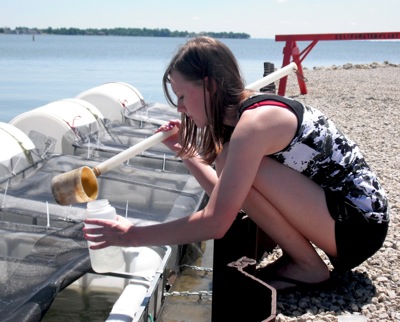
Six tanks filled with lake water are tethered along Grand Lake near Big Bamboo's Dockside Grill. The containers have open tops covered with mesh to let air in and keep debris out.
Two of the tanks (control) contain untreated lake water, two contain lake water seeded with nitrates and two contain lake water seeded with silica and nitrates. Nitrates are found in runoff into the lake while silica is not, Bullerjahn said. Silica is a natural element found in rocks and quartz. Glass is made of silica, Bullerjahn said.
There also are six tanks containing the same amounts of lake water, nitrates and silica at the water treatment plant.
Samples are being taken from all 12 tanks twice a week and lab work is being conducted at the Celina Water Treatment Plant, BGSU and Heidelberg College. The tests are designed to show what types of algae is in the water and if the populations change based upon what is added.
Bullerjahn said the lake experiment site is a more natural setting because the containers are in the water with open tops. The advantage of having a duplicate set of tanks at the plant is they are not exposed and can be monitored and controlled more closely, he said. The containers at the plant also will show how sunlight may be a factor in algae growth, he said.
Bullerjahn said the team plans to run two identical, six-week experiments. The second should wrap up in late July or early August.
If the experiment shows a "friendlier" algae could be stimulated to grow, Algaeventure Systems might consider sectioning off small portions of the lake to harvest it, Bullerjahn said. It is still unknown what effect this might have on the blue-green algae.
Taking the water samples each week is Katrina Thomas, a junior at BGSU and a lifelong resident of St. Marys. Assisting her is Ben Beall, a post-doctorate fellow at BGSU who works with Bullerjahn, and professor Mike McKay.
Thomas said she has been aware of the lake's excess nutrient and algae issues for some time.
"I like to know what is going on and why," she said. "Since I live here, I'm glad I have a hand in helping it."
Local officials have known of Grand Lake's blue-green algae problem, but it was more of a nuisance. It colors the water green, causes slimy slicks on the surface and sometimes kills fish. The problem became an economic nightmare for the area last summer when the state issued a water quality advisory because of a toxin produced by the algae.
The advisory was lifted in April after toxin levels dropped, but a huge algae bloom Monday put the issue back in the spotlight. Excess nutrients that run off farmland is what feeds the blue-green algae.

Harvesting test set this summer:
Algaeventure Systems, Marysville, plans to test algae harvesting equipment in the lake this month.
The test will help determine the feasibility of removing algae from natural bodies of water to use as an energy source, said company spokesman Chad Hummell. The test also will help determine the feasibility of removing nutrients (phosphorous and nitrates) as a way to improve the lake's water quality, he said.
The company's specialty is making algae harvesting equipment. The company grows algae in 11-by-200-foot covered ponds at its Marysville facility, but it has done little work harvesting from natural water bodies, Hummell said.
"Green energies have been gaining popularity especially due to what's happening in the Gulf, but with Grand Lake we have to find a way to help remediate the lake, no matter what the source of the N and P is," Hummell said. "Drawing the algae out is a way to help do that."
Hummell said the lake's blue-green algae isn't conducive for biofuel or bioplastic production but it might be used as a biomass that can be burned to create electricity.
Hummell said removing algae and nutrients isn't the only answer, but just one piece of a larger plan to address the lake's water quality concerns.
"It not the silver bullet, but a thing that can work with all the other stuff going on and add up," he said.
- Nancy Allen