Showing posts with label Eutrophic lakes. Show all posts

Friday, August 15, 2014

Rising CO2 Levels Will Intensify Phytoplankton Blooms in Eutrophic and Hypertrophic Lakes


http://www.plosone.org/article/info%3Adoi%2F10.1371%2Fjournal.pone.0104325

Rising CO2 Levels Will Intensify Phytoplankton Blooms in Eutrophic and Hypertrophic Lakes


Abstract

Harmful algal blooms threaten the water quality of many eutrophic and hypertrophic lakes and cause severe ecological and economic damage worldwide. Dense blooms often deplete the dissolved CO2 concentration and raise pH. Yet, quantitative prediction of the feedbacks between phytoplankton growth, CO2 drawdown and the inorganic carbon chemistry of aquatic ecosystems has received surprisingly little attention. Here, we develop a mathematical model to predict dynamic changes in dissolved inorganic carbon (DIC), pH and alkalinity during phytoplankton bloom development. We tested the model in chemostat experiments with the freshwater cyanobacterium Microcystis aeruginosa at different CO2 levels. The experiments showed that dense blooms sequestered large amounts of atmospheric CO2, not only by their own biomass production but also by inducing a high pH and alkalinity that enhanced the capacity for DIC storage in the system. We used the model to explore how phytoplankton blooms of eutrophic waters will respond to rising CO2 levels. The model predicts that (1) dense phytoplankton blooms in low- and moderately alkaline waters can deplete the dissolved CO2concentration to limiting levels and raise the pH over a relatively wide range of atmospheric CO2conditions, (2) rising atmospheric CO2 levels will enhance phytoplankton blooms in low- and moderately alkaline waters with high nutrient loads, and (3) above some threshold, rising atmospheric CO2 will alleviate phytoplankton blooms from carbon limitation, resulting in less intense CO2 depletion and a lesser increase in pH. Sensitivity analysis indicated that the model predictions were qualitatively robust. Quantitatively, the predictions were sensitive to variation in lake depth, DIC input and CO2 gas transfer across the air-water interface, but relatively robust to variation in the carbon uptake mechanisms of phytoplankton. In total, these findings warn that rising CO2 levels may result in a marked intensification of phytoplankton blooms in eutrophic and hypertrophic waters.

Thursday, October 3, 2013

A mystery at the bottom of the Great Lakes food web


http://michiganradio.org/post/mystery-bottom-great-lakes-food-web

A mystery at the bottom of the Great Lakes food web

There’s a mystery at the very bottom of the Great Lakes food web.
Phytoplankton – the algae that are food for plankton which in turn feed fish – are behaving strangely. They’re surrounded by a nutrient they need to grow. But for some reason, they’re not using it.
The puzzle has big implications for how scientists think about the Great Lakes’ future in a warming world.
Tiny creatures
It’s a crisp sunny morning on the St. Lawrence River. All of the Great Lakes’ water flows through here on its way to the ocean.
Michael Twiss is leaning over the edge of his research boat, his face just a couple inches from the water’s surface. He swishes the water like he’s sniffing fine wine.
“Yup, there’s a fall bloom going on, because we’re at the end of the summer.”
DAVID: “That’s those little sparkly crystals in the water?”
“Yes, that’s what you’re seeing right there. Those are algae.”
Twiss is a limnologist at Clarkson University. He studies algae like this – the bottom of the food web that sustains the Great Lakes’ fishery.
The algae – also called phytoplankton – like to eat nitrate – nitrogen plus oxygen. In all of Great Lakes, there’s loads of nitrate. But get this. Twiss says they’re not eating it.
"The mystery is akin to being at a free smorgasbord and ordering out for pizza. You're going to have to wait longer to get your food, and you're going to have to pay for it."
“The mystery is akin to being at a free smorgasbord and ordering out for pizza. You’re going to have to wait longer to get your food, and you’re going to have to pay for it. So why aren’t they using this nutrient that’s available to them?”
Why should we care what the critters eat?
There are two reasons why this matters. First, if they ate more nitrate, they’d grow and become more food for fish.
Second, the algae would also eat more carbon from the atmosphere, just like trees do through photosynthesis.
“These lakes, which hold 20% of the world’s fresh water, play an important role in sequestering carbon and taking it out of the atmosphere and into the bottom of the lakes. That’s a natural process.”
In fact, the Great Lakes do a better job proportionally at sucking up carbon than the ocean does.
So, if only we could get those phytoplankton to eat more nitrate, we’d have more fish and we’d alleviate climate change at the same time, right?
Not so fast. Climate change cuts both ways.
Andy Bramburger is a researcher at the St. Lawrence River Institute in Cornwall, Ontario. He says the warmer climate is changing the kind of algae in the Lakes – from the kind that’s good for fish to the kind that causes toxic algal blooms and kills fish.
“With climate change and with these fluctuations in temperatures, and the rapid warming we’ve been seeing in the early parts of the spring and summer in recent years, we are tipping the balance in favor of algae that are not favorable to our use of waterways,” he says.
The detective cracks the case... a little
Michael Twiss recently made a tiny breakthrough in the phytoplankton mystery. Phytoplankton also need trace metals to eat the nitrate. So when he sprinkled the trace metal molybdenum into water samples – poof – the algae feasted like it was a smorgasbord.
Twiss’ hypothesis is that invasive species like zebra mussels have sucked too many metals and other nutrients out of the water. Twiss says it may be a new paradigm.
“A shift in the way the ecosystem is operating, and it’s up to us to understand how it operates so we can predict what will happen in the future, and so we can manage for change, particularly climate change.”
To protect our clean waters, our fishery, and our relationship with the Great Lakes in the face of climate change, scientists will have to puzzle out the mysteries at the bottom of the food web."
-------------------------------
We have understood the food web and invented a Nano Silica based micro nutrient product to grow Diatom Algae in large lakes.


Wednesday, February 6, 2013

Lake Winnipeg 'wins' Threatened Lake of the Year award


http://www.winnipegfreepress.com/local/Lake-Winnipeg-wins-Threatened-Lake-of-the-Year-award-189678361.html


Lake Winnipeg has made an inauspicious list after being declared "Threatened Lake of the Year, 2013" by the Global Nature Fund.
Not a great surprise, according to environmental activists.
"Scientists have been warning us about Lake Winnipeg’s future as far back as 1969," said Vicki Burns, Outreach Coordinator for the Lake Winnipeg Foundation (LWF). "They warned that we needed to decrease the nutrients that are causing the toxic blue-green algae blooms back then. Yet, despite these warnings the action to clean up the lake has been very slow. However, the embarrassment that goes with a global recognition of such dubious distinction, is actually galvanizing the LWF and our important partners. We are more determined than ever to save our lake."
However, Burns noted that the quality of the lake can be "stymied, and ultimately, reversed." Burns cited Lake Constance, bordered by Switzerland, Austria and Germany, which the LWF said was considered even more polluted than Lake Winnipeg and has now been cleaned up so well that it provides drinking water to surrounding communities.
According to Burns, the LWF is currently leading development of an action plan that will focus on science and is engaging and collaborating with key stakeholders in the Lake Winnipeg situation.
"Perhaps more than we recognize, Lake Winnipeg has a strong global connection because of its home in Canada’s vast prairie region known as the World’s Breadbasket," added Alex Salki, chair of the LWF Science Advisory Council. "In our quest to feed the world, we are nevertheless fueling Lake Winnipeg eutrophication by removing the nutrient buffering capacity of wetlands, altering natural stream courses, and reducing habitat biodiversity. And of course, we are all aware of the urban and municipal impacts on the lake as well.
Udo Gattenjohner, of the Global Nature Fund, said while Lake Winnipeg is one of the largest lakes in the world, it’s "dramatic environmental problems" are less well known. Gattenjohner said "recent changes in Canadian polities seem to be eroding the protection, particularly of vulnerable water ecosystems – and it is disappointing because this does not really fit with our image of Canada."

Saturday, December 8, 2012

Clean Hussainsagar Campaign

http://www.thehindu.com/news/cities/Hyderabad/hussainsagar-dredging-work-initiated/article4175393.ece


Hussainsagar dredging work initiated

Chief Minister also launches the ‘Clean Hussainsagar’ campaign
As part of a year-long initiative to get rid of pollutants from Hussain Sagar Lake, dredging work at the water body was initiated on Friday.

Sediments

The massive exercise launched by the Chief Minister, N. Kiran Kumar Reddy, will help to scoop out sediments to the tune of 10 lakh cubic metre from the confluence points of four inlets of the lake.

The dredging of sediments at three inlets, Balkapur nala, Picket nala and Banjara nala, has started while the work on Kukaptally nala confluence point will be initiated at a later date since sediments here were found to be hazardous.

JICA

One of the major aspects of the Hussainsagar Lake and Catchment Area Improvement Project, the exercise would have the dredged out sediments dried and shifted to existing quarry pits at Jawaharnagar dump yard.

The lake, which has been polluted due to untreated sewage and industrial effluents generated in the catchment of 240 square km through the four inlets, is being restored with the assistance of Japan 

International Cooperation Agency (JICA) to the tune of Rs. 370 crore.

Apart from dredging work, the Chief Minister on Friday also launched the ‘Clean Hussainsagar’ campaign, commissioning of upgraded tertiary level 20 MLD STP at Khairatabad and the 1400 mm Balanagar sewer main.

Reuse of water

The STP has been upgraded to the tertiary level and according to HMDA officials, the treated water would be processed for ultra-filtration by membranes procured from Australia.

The water then gets disinfected of pathogenic bacteria to achieve a quality, which the officials described would be fit for reuse, for non-potable purposes.

Speaking on the occasion of the launch, the Chief Minister called for a concerted effort involving all stakeholders to clean Hussainsagar Lake.

Efforts are on to clean and restore several other smaller water bodies in the city and tough action is in store for those taking up illegal constructions alongside them, he said.

In his address, Labour Minister D. Nagender said the HMDA should not remain mute in issues that threaten the lake and cautioned senior officials of action in case they failed to take steps needed to protect the water body.

Hussainsagar - The lake that was

http://articles.timesofindia.indiatimes.com/2012-12-08/hyderabad/35688897_1_water-hyacinth-lake-bid-farewell


The lake that was

Chandana Chakrabarti Dec 8, 2012, 07.19AM IST
The Hyderabad of my childhood was so uneventful that a trip to Husainsagar was the highest form of entertainment , a memory one ruminated on for months. In the sixties, the raw beauty of a much larger lake enticed one and all. Tankbund road was narrow, pavements non-existent , and traffic so thin that a snail crossing the road would not run the risk of being run over. The lower tank bund road was a narrow dirt track lining a green expanse of paddy fields . Hotel Marriott stands where a Coca Cola bottling plant, a regular target for school excursions, stood. Connecting the upper and lower Tankbund roads were narrow stone steps on the wall of the bund. We used these steps to go Bharat Sevashram Sangha on the lower road for a community meal at Kali puja on Diwali.
For the non-adventurous , the lake was approachable from the Secunderabad Sailing Club or the Hyderabad Boat Club on the opposite end. A bus ride on the top deck of a doubledecker bus through Tankbund was enticing . Racing records were broken and set on Tankbund road.
A small kebaband-paratha shop opposite the lakeside and a restaurant at the level of water on the Tankbund road which had an open shelter as a roof-top , were favourite haunts. Bongs had their fi ll of fish from the closeby stall of the fisheries department. In the late seventies , water hyacinth aggressively claimed the lake, making it look like a vast green expanse. The battle against it was not easy and became almost a full-time research obsession with RRLabs.
Every Durga puja, on Dashami, Durga was bid farewell in the lake by half-a-dozen Bengali clubs who used Hyderabad Boat Club premises for immersion . More than faith, it was our only chance to get on an open lorry, shout, sing, dance and be boisterous. The unique sight of the army puja's amphibian truck, which moved on land and water attracted crowds and made us feel proud. Ganesh festival till the end of seventies was virtually unknown in Hyderabad. Since then with every passing year Ganesh immersion has only grown larger and more aggressive , contributing to the lead, mercury and cadmium levels of the lake, besides the silt. Bongs are, perhaps, to be blamed for showing the way.
Through the eighties and nineties, dramatic changes swept the lake's environs . Tankbund road got broadened, beautified and statuefied ! The Buddha Purnima Project got underway, the Necklace road came up, and the monolith Buddha was transported prostrate on a huge vehicle with over a hundred wheels, only to fall in the lake on its way to the rock of Gibralter , killing several people.
But there were other ugly things happening along with the beautifi cation . Patancheru industrial estate's effluents and the city's sewage began to get free access to the lake. The clear water of the lake went so turbid that Buddha's rescue was a nightmare. Stench around the lake became insufferable. Governor Kumudben Joshi as also Governor Kishan Kant would lament in personal conversation about how the stench obliterated the joy of an enticing view from their residence. Then came a time when eating the lake's fi sh could endanger one's health.
Although Husainsagar's beautifi cation has enraptured everyone, the lake has been dying a slow death. Moreover , the banks of Husainsagar has become the best destination for the lastjourney of our politicians. And who knows, the fate of Masab tank might befall Husainsagar in a few decades, and then the transition from a park to a mall will be only a matter of real estatestrategy!
Time and again, independent organisations have run extensive experiments to study the water quality of the Hussainsagar. The results, each time, have thrown up startling facts about the deteriorating condition of the city's most important water body. Excerpts from some of those studies:
National Environmental Engineering Research Institute: 1997-98

This water quality assessment was conducted by NEERI on the request of the Hyderabad Metropolitan Water Supply & Sewerage Board. The study revealed a very low, and in some locations zero, presence of dissolved oxygen (DO) in the Hussainsagar thereby indicating the fragile lake water quality and the effect of organic pollution. The study concluded that the lake was in an advanced stage of 'Eutrophication' , which means that there was an increased plant growth in the water body. According to experts this accelerated growth is either due to natural fertilizing agents washed from the soil or dumping of chemical fertilizers. Eutrophication may also occur due to drainage of sewage, industrial wastes or detergents into a body of water.
Ecology & Environment Group, National Geophysical Research Institute: 2007-08
The paper was prepared by members of NGRI and points to the risk posed to the aquatic environment of Hussainsagar, thanks to the presence of heavy metals in the water, especially lead. Tracing the pollution 'history' of the lake, the study points out how the water body initially did absorb the pollution impact. But once its natural carrying capacity reached its limits, adverse effects of the pollution started manifesting around 1970 in the form of deteriorating water quality, fowl smell, wild growth of macrophytes and breeding of mosquitoes. By 1992, according to the paper, the lake was reduced to a cesspool.
As part of a comprehensive report on the water situation in India, 'Excreta Matters' , the centre also studied the situation of water bodies in Hyderabad. It concluded that the Hussainsagar, once a primary source of drinking water of the city, had shrunk significantly over the years and was posed with a serious threat from pollution and encroachment in this catchment area.

Sunday, January 1, 2012

Lakes and Green House Gases

http://www.lakescientist.com/learn-about-lakes/lakes-climate-change/lakes-and-greenhouse-gases.html

Greenhouse Gases
By Kevin Rose | Miami University


Figure 1: Greenhouse gases, especially CO2, are increasing in the atmosphere due to human activities. Natural sources of greenhouse gases include lakes and other freshwater resources.
Gases that trap heat in the atmosphere are known as greenhouse gases. The major greenhouse gases are carbon dioxide (CO2), methane (CH4), and nitrous oxide (N2O)1. At present, atmospheric CO2 is nearly 35% higher than preindustrial levels and is increasing1. Although these gases are released from natural activity, human activity is responsible for the increase of greenhouse gases in the atmosphere. According to both the European Environment Agency and the United States Environmental Protection Agency, CO2 emissions account for the largest share of total greenhouse gas emissions, equivalent to 80-85% of total emissions. Fossil fuel combustion used for transportation and electricity generation are the main source of CO2 emissions, contributing to more than 50% of total emissions.

Natural sources of greenhouse gases include lakes and other freshwaters such as rivers, streams, ponds, and wetlands as well as terrestrial landscapes such as forests and fields. Lakes are active, changing, and important regulators of (CO2), methane (CH4), and nitrous oxide (N2O).

Carbon Dioxide

Figure 2: Carbon Dioxide (CO2) is an important greenhouse gas, and most lakes act as net sources of CO2, releasing it into the atmosphere. Lakes also bury large amounts of carbon in their sediments, over three times more than the world’s oceans.
Lakes play a much greater role in global carbon cycling than their area would otherwise predict. While lakes make up less than 2% of Earth’s surface area, they bury over three times more carbon in their sediments than all of the world’s oceans combined2. This means on a per area basis lakes bury over 100 times more carbon than the oceans. Small lakes that contain large amounts of algae tend to bury the most carbon; thus, the small drainage ponds, farm ponds, and recreational lakes around the world are important sites for carbon cycling and understanding global climate change3.

Despite the fact lakes bury huge amounts of carbon, they also tend to release more carbon dioxide to the atmosphere than they absorb, making them net sources of greenhouse gases. Most of the world’s lakes are supersaturated in CO2 and consequently release some of it to the atmosphere4. In fact, lakes and other freshwaters release almost as much CO2 as all the world’s oceans. This occurs because lakes generally drain large landscapes and the carbon from forests, fields, and lawns becomes concentrated in lakes where it can be buried or released into the atmosphere. Research studies show that the CO2 released from lakes comes from organism respiration — the breathing of bacteria, algae, zooplankton, fish, and other species5.


Methane
While methane is less common than CO2, it is a highly potent greenhouse gas. It has about 20 times more warming potential than CO2. Lakes contribute about 10% of total natural methane emissions, and they produce more methane than the oceans6. Many lakes and other freshwaters produce methane during warm summer conditions or when oxygen levels underwater drop. Most methane is produced in lake sediments when oxygen is no longer present due to different communities of bacteria that grow in environments without oxygen. In some lakes, bubbles can be seen rising from sediments; these bubbles are often methane produced by bacteria in oxygen deprived sediments6. Shallow areas around the shores of warm lakes are hot spots for methane production. Overall, lakes are important sites for carbon dioxide and methane production and release.

Nitrous Oxide
Lakes and other freshwater resources are also sources of nitrous oxide (N2O) cycling, another potent greenhouse gas that is produced in warm lakes by bacteria and other microbes. Within lakes, shallow sediments contribute most to N2O emissions7, while organisms in deep open waters may consume more N2O than they release. Lake shape may be an important predictor of N2O release, as shallow lakes with expansive shorelines may release more N2O than they produce compared with round deep lakes.

Is Hydroelectric Power a “Green” Energy Source?
Lakes and reservoirs are often built or used to generate power. In fact, so much water is retained behind dams that global sea level rise has been reduced by about 0.02 inches (0.55 mm) per year over the past 50 years8. Because fossil fuels are not used to produce hydroelectric power, lakes and reservoirs are often thought of as “green” energy sources. But lakes and reservoirs release potent greenhouse gases — particularly carbon dioxide and methane — into the atmosphere. If a hydroelectric dam releases enormous volumes of greenhouse gases, is it a “green” energy source?


Figure 5: The Three Gorges Dam in China is the world’s largest producer of hydroelectric power. Lakes and reservoirs emit greenhouse gases, and studies have questioned whether hydroelectric is truly a “green” energy source.
Greenhouse gas emissions from freshwater lakes and reservoirs and their contribution to the increase of greenhouse gases in the atmosphere are at the heart of a worldwide debate concerning the electricity generating sector9. Hydropower represents about 20% of the world’s electricity generation capacity and on average emits 35 to 70 times less greenhouse gases per unit power generated than thermal power plants10. When reservoirs are first built for power generation, soils, plants, and trees are flooded. The decay of this plant and soil material can contribute to large emissions of CO2 and CH4 during the first few years after reservoir construction11. Studies show that 3-10 times more greenhouse gases are produced by newly formed reservoirs than from natural lakes of the same size in the first 2-5 years after a reservoir is constructed12.

Beyond the initial release of greenhouse gases, lakes and reservoirs also continue to release carbon dioxide and methane as they produce power. As methane and carbon dioxide enriched water passes through turbines, hydrostatic pressure drops and a large portion of the gas rapidly escapes to the atmosphere. In some regions, such as tropical reservoirs where methane production can be high, reservoirs can release more greenhouse gases than fossil fuel alternatives13.

While lakes and reservoirs used to generate hydroelectric power can release greenhouse gases, they typically release far smaller amounts than traditional fossil fuel based power plants. Hydroelectric is not a perfectly “green” energy source, but it is often much more environmentally friendly than alternative choices and can be part of an alternative energy solutions plan.

Thursday, January 6, 2011

Lakes a big source of climate-warming gas: study


Lakes a big source of climate-warming gas: study

OSLO | Thu Jan 6, 2011 2:47pm EST

(Reuters) - Lakes and rivers emit far more of a powerful greenhouse gas than previously thought, counteracting the overall role of nature in soaking up climate-warming gases, a study showed on Thursday.

A review of 474 freshwater systems indicated they emitted methane equivalent to 25 percent of all carbon dioxide -- the main greenhouse gas blamed for stoking climate change -- absorbed by the world's land areas every year.

Trees and other plants absorb carbon dioxide as they grow.

"Methane emissions from freshwater sources were greater than expected," David Bastviken, lead author of the study at Linkoping University in Sweden, told Reuters.

"Some of the carbon that is being captured and stored by the Earth will be counteracted by methane from these freshwater sources," according to the study by experts in Sweden, the United States and Brazil in the journal Science.

Emissions of methane, released by decaying vegetation and other organic matter in rivers, reservoirs, lakes and streams, have not previously been properly built into models used to understand global warming, Bastviken said.

The findings indicate that other parts of the landscape, led by forests, should be prized more as the most robust natural stores of greenhouse gases, he said.

"This means that forests and other local environments, being carbon sinks, are even more important" in helping offset global warming, he said. Land-based stores "may be more rare than expected."

LONG IGNORED

Bastviken said the freshwater methane emissions were not a new environmental threat since the presence of the gas in the atmosphere was previously known, even if scientists were unsure where it came from.

"This has always happened. We just haven't paid attention," he said. Even so, he said a thaw of permafrost in places from Siberia to Alaska may also be releasing more methane from once frozen soils.

A U.N. climate conference in Cancun, Mexico, last month agreed to set up a system to slow deforestation, from the Amazon to the Congo basin, to help slow climate change.

The plan envisages incentives for developing nations to safeguard forests rather than clear them to make way for farmland, towns or roads. Deforestation accounts for perhaps 10 percent of greenhouse gases from human activities.

A build-up of greenhouse gases, mainly from burning fossil fuels in power plants, factories and cars, will cause more heatwaves, floods, droughts and rising sea levels, according to the U.N. panel of climate scientists.

Methane is about 25 times more powerful than carbon dioxide as a greenhouse gas.

Bastviken said the findings were not an argument for draining wetlands or lakes to limit methane emissions -- that might well backfire and release carbon stored in sediments.

(Editing by Janet Lawrence)


Sunday, June 20, 2010

Grand Lake Ecosystem Experiment - Diatom


Testing to grow profitable lake algae
local picture
GRAND LAKE - Some professors and a local student at Bowling Green State University are experimenting with Grand Lake water to get a less harmful type of algae to grow so it can be harvested.
The experiment, a collaboration between BGSU, the city of Celina and Algaeventure Systems, Marysville, began about four weeks ago.
In March, Celina officials met with professors who are researching Lake Erie algae issues. Similar to Grand Lake, Lake Erie has blue-green algae that produces a potentially harmful toxin.
"They wondered if there was a way to influence the water so a strain of algae that doesn't make the toxin could be grown," Celina Planning and Community Development Director Kent Bryan said. "Naturally we were interested."
Bryan has been looking into the possibility of harvesting the lake's algae for biofuel production for a couple years, but the strain in Grand Lake won't work because it is low in lipids (oil).
Algae higher in lipids is better for producing products such as biofuels, bioplastics and animal feed, said Chad Hummell of Algaeventure Systems.
"We thought if we could manipulate the nutrient contents we could change the composition of the algal community to something less harmful," said George Bullerjahn, one of the biology professors working on the project. "We are proposing that if we increase the amount of silica in the water, we can get a friendlier algae called diatoms to grow and be less toxic."
Diatom algae is a good source of oil, which makes it a good source for biofuel and bioplastic production, he said.
Passers-by driving onto West Bank Road may have noticed one of the experiment sites marked as Grand Lake Ecosystem Experiment (GLEE).
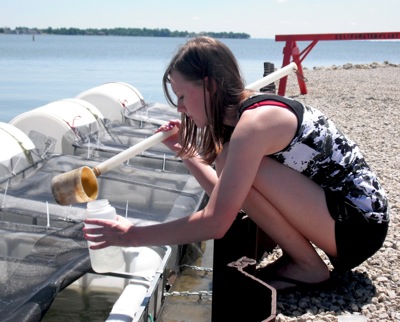
Six tanks filled with lake water are tethered along Grand Lake near Big Bamboo's Dockside Grill. The containers have open tops covered with mesh to let air in and keep debris out.
Two of the tanks (control) contain untreated lake water, two contain lake water seeded with nitrates and two contain lake water seeded with silica and nitrates. Nitrates are found in runoff into the lake while silica is not, Bullerjahn said. Silica is a natural element found in rocks and quartz. Glass is made of silica, Bullerjahn said.
There also are six tanks containing the same amounts of lake water, nitrates and silica at the water treatment plant.
Samples are being taken from all 12 tanks twice a week and lab work is being conducted at the Celina Water Treatment Plant, BGSU and Heidelberg College. The tests are designed to show what types of algae is in the water and if the populations change based upon what is added.
Bullerjahn said the lake experiment site is a more natural setting because the containers are in the water with open tops. The advantage of having a duplicate set of tanks at the plant is they are not exposed and can be monitored and controlled more closely, he said. The containers at the plant also will show how sunlight may be a factor in algae growth, he said.
Bullerjahn said the team plans to run two identical, six-week experiments. The second should wrap up in late July or early August.
If the experiment shows a "friendlier" algae could be stimulated to grow, Algaeventure Systems might consider sectioning off small portions of the lake to harvest it, Bullerjahn said. It is still unknown what effect this might have on the blue-green algae.
Taking the water samples each week is Katrina Thomas, a junior at BGSU and a lifelong resident of St. Marys. Assisting her is Ben Beall, a post-doctorate fellow at BGSU who works with Bullerjahn, and professor Mike McKay.
Thomas said she has been aware of the lake's excess nutrient and algae issues for some time.
"I like to know what is going on and why," she said. "Since I live here, I'm glad I have a hand in helping it."
Local officials have known of Grand Lake's blue-green algae problem, but it was more of a nuisance. It colors the water green, causes slimy slicks on the surface and sometimes kills fish. The problem became an economic nightmare for the area last summer when the state issued a water quality advisory because of a toxin produced by the algae.
The advisory was lifted in April after toxin levels dropped, but a huge algae bloom Monday put the issue back in the spotlight. Excess nutrients that run off farmland is what feeds the blue-green algae.

Harvesting test set this summer:
Algaeventure Systems, Marysville, plans to test algae harvesting equipment in the lake this month.
The test will help determine the feasibility of removing algae from natural bodies of water to use as an energy source, said company spokesman Chad Hummell. The test also will help determine the feasibility of removing nutrients (phosphorous and nitrates) as a way to improve the lake's water quality, he said.
The company's specialty is making algae harvesting equipment. The company grows algae in 11-by-200-foot covered ponds at its Marysville facility, but it has done little work harvesting from natural water bodies, Hummell said.
"Green energies have been gaining popularity especially due to what's happening in the Gulf, but with Grand Lake we have to find a way to help remediate the lake, no matter what the source of the N and P is," Hummell said. "Drawing the algae out is a way to help do that."
Hummell said the lake's blue-green algae isn't conducive for biofuel or bioplastic production but it might be used as a biomass that can be burned to create electricity.
Hummell said removing algae and nutrients isn't the only answer, but just one piece of a larger plan to address the lake's water quality concerns.
"It not the silver bullet, but a thing that can work with all the other stuff going on and add up," he said.
- Nancy Allen

Monday, November 2, 2009

13th World Lake Conference

http://www.istockanalyst.com/article/viewiStockNews/articleid/3597052

istockAnalyst.com (press release) - Salem,OR,USA

China has more than 24800 natural lakes. However, an average of 20 lakes disappeared every year, and about 88.6 percent of the lakes (2180) are in eutrophic state, ...

Chen, vice chairwoman of the Standing Committee of the National People's Congress, China's top legislature, made the comment in an address to the 13th World Lake Conference that opened Monday in Wuhan, known as "the city of a hundred lakes".